



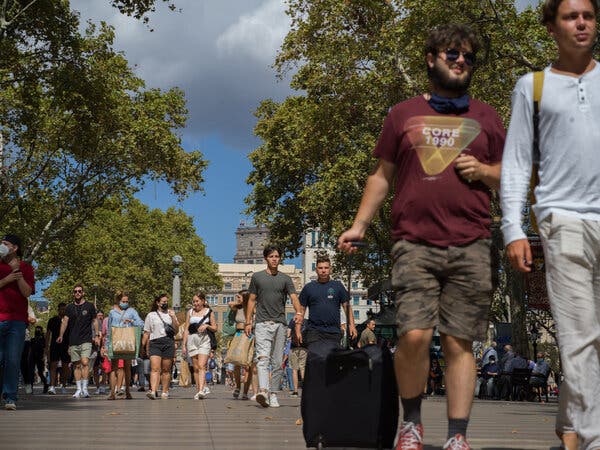
Tourists stroll along Las Ramblas, the popular street in the heart of Barcelona. A new rule prohibiting short-term private room rentals is taking a significant proportion of home-sharing options off the market.Credit…Samuel Aranda for The New York Times
By Paige McClanahan
Sept. 22, 2021
GET THE TRAVEL DISPATCH NEWSLETTER Essential news on the changing travel landscape, expert tips and inspiration for your future trips. Get it sent to your inbox.
It’s been a busy summer for Lucas Ezequiel Hernández, a 29-year-old designer who lives with his brother in central Barcelona. In June, he listed the extra bedroom in their apartment on Airbnb, and for more than two months, hosted a steady stream of tourists at a rate of 40 euros, or about $47, per night. But by the end of August, a couple of weeks after a new ban on short-term, private-room rentals had taken effect, he was reconsidering his options.
“I think I’m going to cancel the reservations that I have,” said Mr. Hernández, who added that he had used his rental earnings to help fund the launch of his fashion brand. “I can get problems by renting on Airbnb, so I think I’m not going to do it anymore.”
The ban, which took effect on Aug. 6, sets Barcelona apart as the only major city in Europe to have forbidden short-term private room rentals, even as it continues to allow the renting of entire apartments — so long as the owner of the property holds the appropriate license.

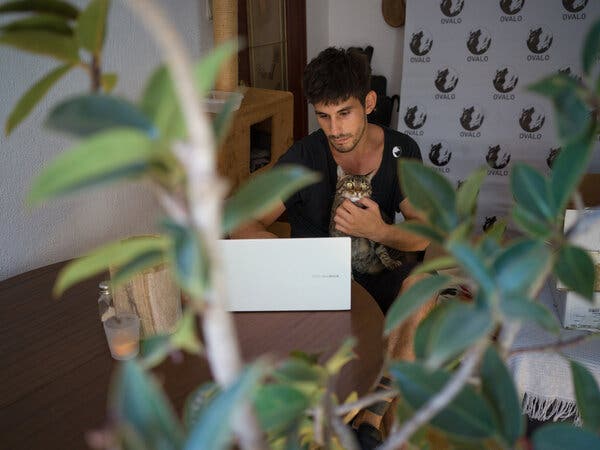
Lucas Ezequiel Hernández hosted a steady stream of tourists at a rate of 40 euros, or about $47, per night, for a room in his apartment. But by the end of August, a couple of weeks after a new ban on short-term, private-room rentals had taken effect, he was reconsidering his options.Credit…Samuel Aranda for The New York Times
The new rule has added fuel to Barcelona’s already-heated debate over how to support the local economy and safeguard residents’ quality of life following the rapid growth in tourism in the decade before the pandemic hit. Critics maintain that the crackdown on accommodations has resulted in unjustifiably heavy fines for hosts and cut out an important source of income for many residents. But the city government says that restricting private tourist accommodation is one of the few effective tools that it can deploy to rein in excessive tourism and address the city’s housing problems.
“We are very happy that people come to Barcelona and enjoy Barcelona because we love our city and we want to share it — but we need rules and we need balance,” said Janet Sanz, Barcelona’s deputy mayor and the driving force behind the crackdown. “People in Barcelona can still rent out a room for a year to a student coming from abroad,” she added. “But for less than 31 days, it’s such a tricky market to regulate that, from now on, we have to stop it.”
Airbnb maintained that its rentals do no harm to the city, and that half of its hosts in Barcelona rely on the income to pay their bills and stay in their homes.
“In Barcelona, the absence of clear rules for hosts who share a room in their home has no impact on our business, but we are concerned about the negative impacts of City Hall’s proposals on local families,” said Patrick Robinson, Airbnb’s head of policy for Europe, the Middle East and Africa. “We are confident that we can work with the authorities on a better way forward.”
The beginnings of a problem
Forty years ago, Barcelona wasn’t high on most tourists’ lists of must-see cities in Europe. But that changed after the city hosted the Summer Olympics in 1992: An enormous public investment in beautifying the city coincided with a prime spot on the global stage. A new “destination” was born.
Attracted by the city’s museums, restaurants, architecture and Mediterranean coastline, tourists arrived from across Europe and around the world. By 2019, Barcelona — a city of about 1.6 million — registered over 21.3 million overnight stays, more than double the figure from 2005. And that’s not even counting the more than three million cruise ship passengers who passed through the city’s port that year.
When Airbnb arrived in 2009, Barcelona had no specific regulations governing private rentals to tourists, but interest in the service was evident: By the middle of 2016, there were some 20,000 listings of both private rooms and entire apartments in Airbnb’s Barcelona section, according to data from Inside Airbnb, which tracks listings in cities around the world. The hosts in Barcelona were operating in a kind of “gray market” in those early years of growth: It wasn’t explicitly legal, nor was it clearly forbidden.
But as tourist numbers grew, so, too, did the sense among many in Barcelona that the city was nearing its capacity for visitors. In the summer of 2014, anti-tourism protests erupted in the Barceloneta neighborhood, where locals had grown frustrated with the noise and raucous behavior of visitors who had come to party. Anti-tourism graffiti sprouted up, sometimes in popular tourist spots, and in 2017, a group of left-wing activists vandalized an open-top bus filled with tourists. Many residents — as well as some at City Hall — pointed the finger at Airbnb.
“For a long time, tourism was seen as nothing but a positive thing for the city, but now we’re starting to feel all of the impacts,” said Mar Santamaría Varas, a Barcelona-based architect and co-founder of 300.000 Km/s, an urban planning agency. With regard to tourist accommodation, she added that her analysis has revealed three main problems: gentrification, crowding in public spaces, and the disappearance of corner stores and other retailers that are essential for residents.
Airbnb maintains that private room rentals have little to no impact on the availability of local housing, as people who rent out private rooms live in the same property. But a study published last year in the Journal of Urban Economics found that Airbnb activity in Barcelona has increased rents by 7 percent and housing prices by 17 percent in the neighborhoods that have the highest levels of activity on the platform. In the average neighborhood, the effects were a 1.9 percent increase in rent and a 4.6 percent increase in housing price.
A new era
The 2015 election of Ada Colau as Barcelona’s mayor marked a turning point in the city’s relationship with tourism, ushering in the first real efforts to regulate short-term rentals. Already famous in Spain for her work fighting housing evictions, the left-wing Ms. Colau took a much harder line on tourism than her predecessor. Under her leadership, City Hall enacted a moratorium on new tourist licenses for entire-apartment rentals; launched a major crackdown on illegal apartment listings; banned the construction of new hotels in the city center; and introduced neighborhood-specific rules to regulate the establishment of souvenir shops and other businesses that cater to tourists.
But in other ways, the city’s hands were tied. Legally, the Colau administration couldn’t revoke the roughly 10,000 tourist licenses that the previous administration had issued for the renting of entire apartments, said Ms. Sanz, the deputy mayor. At the same time, rules governing both the Barcelona airport and port — which is the largest cruise ship harbor in the Mediterranean — remain beyond the jurisdiction of City Hall.
But so-called home-sharing — the renting of a room inside a home — remained unregulated, and thus became a target for the city’s tourism control measures. Indeed, the market in Barcelona had started to shift away from entire apartments and toward private rooms just as the crackdown on illegal listings picked up.
According to data from Inside Airbnb, the number of private room listings in Barcelona overtook entire home listings for the first time in 2017. As of Aug. 8 of this year, two days after the short-term private room rentals took effect, 45 percent of the more than 16,000 active Airbnb listings in Barcelona were for private rooms. When a journalist approached 20 of these hosts to request a one-week tourist stay in their private room rentals — which would be illegal under the current law — within a day, half of the hosts had responded with an invitation to reserve.
Enforcing the rules
Mr. Robinson of Airbnb said that the company has cooperated with the city in regulating the activity on its platform. He added that Airbnb requires hosts to agree to allow certain personal details — including their name, address and national identification number — to be shared with authorities, and said that more than 7,000 rule breakers have been removed because of Airbnb’s collaboration with City Hall.
“Airbnb has always reminded hosts to follow local rules before they list on the platform,” Mr. Robinson said. “We also provide hosts with clear information about the latest regulation in Spain.”
As for the ban on short-term private room rentals, Airbnb questioned whether the new regulation affected rentals to business travelers or other types of non-tourist visitors, and said that it was impossible for the company to distinguish between such types of guests. But a company spokesman said that Airbnb would remove any private room listings from the platform if City Hall officially requested it do so.
Ms. Sanz insisted that there are no exceptions to the law, including for business travelers. She added that the city is gathering the information it needs to make its official takedown request for short-term private room rentals.
More broadly, Ms. Sanz said, one of City Hall’s biggest complaints with Airbnb is that the company continues to allow new hosts of apartments to declare themselves “exempt” from the law that requires them to have a tourist license, without asking them to provide any evidence to that effect. She added that Airbnb has taken down illegal listings that have reappeared on the platform, sometimes days later. She worries that the same will happen with room rentals.
“This is a major problem that we have now, and we have been having it with Airbnb for the past several years,” said Ms. Sanz. She added that such problems have put tremendous pressure on City Hall, which now spends 2 million euros per year to inspect Airbnb listings and enforce the city’s rules on home-sharing and tourist apartment rentals.Ms. Sanz added that the city has found that many hosts are professionals who are “speculating” on the housing market, not individuals looking to cover their basic needs.
Data from Inside Airbnb show that, as of Aug. 8, 27 percent of Barcelona’s private room listings were in a portfolio of three or more private rooms, while 54 percent of the private rooms were offered by hosts who had only a single listing. Airbnb disputed these numbers.
“This data is flawed. Public scrapes of our site use inaccurate information and flawed methodology to make misleading assumptions about our community,” an Airbnb spokesman said. “As of Aug. 8, 2021, 78 percent of private room listings in Barcelona were offered by hosts with only one private room listing; 93 percent were offered by hosts with one or two private room listings only.”

Martha Ruiz, an Airbnb host, has recently stopped taking reservations for her short-term, private-room guests. “They can regulate, yes,” she said, “but not prohibit something that isn’t doing any harm to anyone.”Credit…Samuel Aranda for The New York Times
Hosts respond
Manel Casals, the general manager of Barcelona’s hotel association, welcomed the ban, saying that Airbnb is “a concern for cities everywhere” because it deprives local governments of taxes, disrupts residential areas, and fails to ensure adequate health and safety standards for guests. “It will help Barcelona to prohibit this,” he said, adding that the city’s hotels don’t consider Airbnb a competitor as they serve a different customer base.
But Airbnb hosts like Martha Ruiz were disappointed with the ban. Ms. Ruiz, who lives near Barcelona’s Collserola Park, stopped taking reservations for short-term guests following the imposition of the ban in August.
“I don’t know what they are doing, why they want to prohibit it,” said Ms. Ruiz, an Airbnb host since 2017. “They can regulate, yes — but not prohibit something that isn’t doing any harm to anyone.”
Jose Luis Rodriguez Fried, the legal representative of Veïns i Amfitrions de Catalunya, an association of roughly 500 Catalonian hosts that has lobbied the government on home-sharing regulations, said that Barcelona’s ban on short-term private room rentals was “unjustified” and “undemocratic.”
“The paradox is that we have a Barcelona City Council with progressive roots that is supposedly sensitive to the problems of residents and the community, but their response has been to erect a barrier behind an ideological, anticapitalist message instead of taking advantage of the system on behalf of the city and its inhabitants,” Mr. Rodriguez Fried said.

The swimming pool at Martha Ruiz’s home.Credit…Samuel Aranda for The New York Times
“By renting out their rooms, these people have found a way to pay their rents and mortgages,” he added. “Now they are again at risk of losing their homes and also, let’s be honest, their dignity.”
Hosts who violate the city’s rules risk attracting the attention of inspectors, and sanctions start at 6,000 euros. Plenty of fines have already been imposed: Since 2016, City Hall has initiated more than 9,000 legal proceedings against hosts who were breaking the rules. Ms. Sanz said that a crackdown on private room rentals will begin soon.
Policymakers across Europe will no doubt be watching how things play out in Barcelona, which is a member of an association of nearly two dozen European cities — including Amsterdam, Paris and Prague — that are lobbying European leaders to support their efforts to regulate tourist rentals.
Cities that take such a strong stance on the issue can ultimately compel Airbnb to cooperate, said Daniel Guttentag, an assistant professor of hospitality and tourism management at the College of Charleston in South Carolina.
“When cities are cracking down in a way that is more aggressive than Airbnb would like, then the company absolutely plays hardball and fights back to push for regulations that they find to be more amenable,” Dr. Guttentag said.
“There are examples of Airbnb participating in enforcement,” he added, citing cases in San Francisco, London and Paris. “But this is only when they’ve really been obligated to do so.”